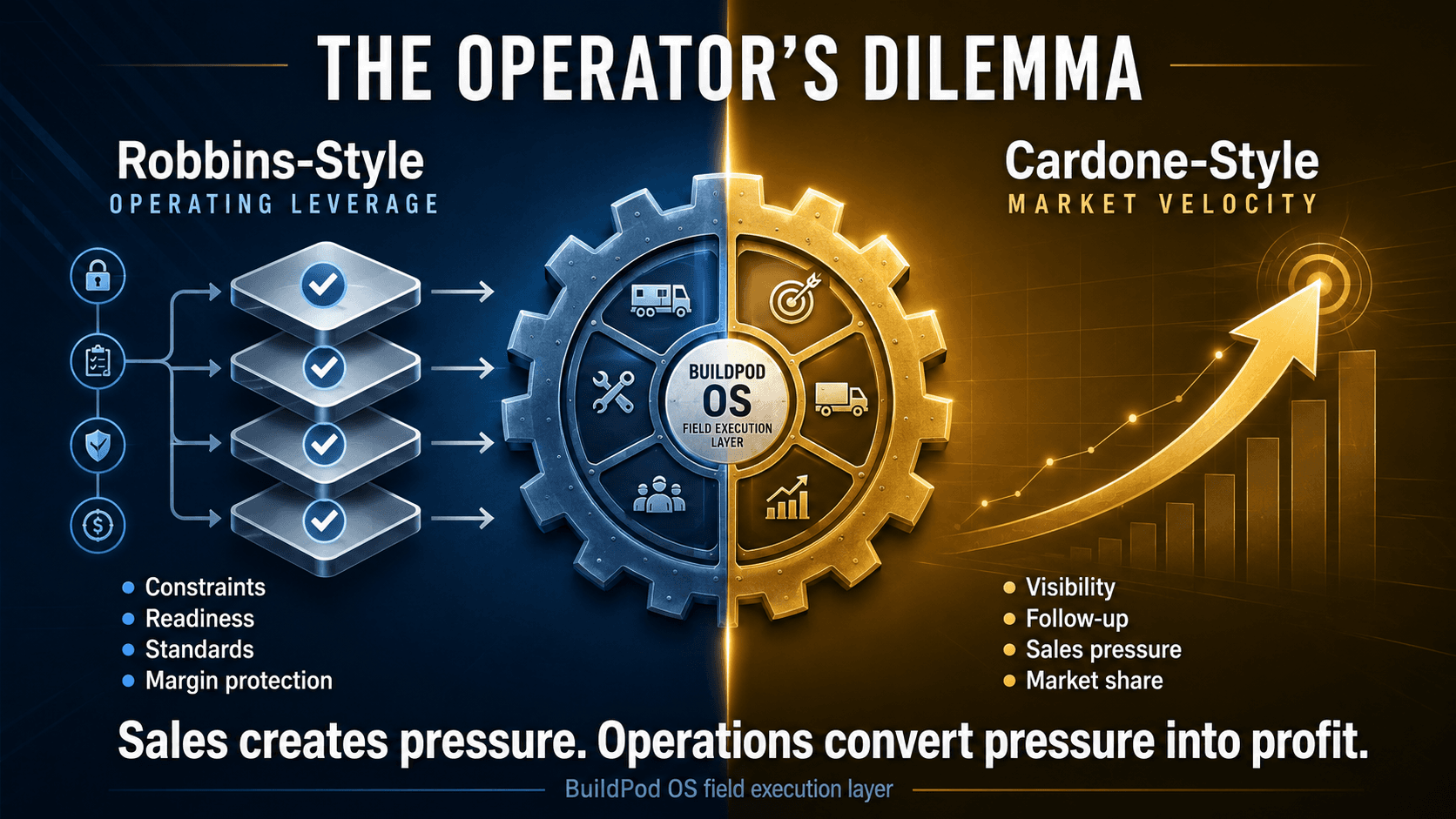
The two scaling instincts
On one shoulder sits the Cardone-style voice: get attention, make offers, follow up harder, stay visible, create market pressure. For many owners, that correction is necessary. Obscurity is expensive. A field business that nobody sees eventually becomes a well-organized secret.
On the other shoulder sits the Robbins-style voice: find the choke point, stop being the bottleneck, raise standards, improve the machine, and remove the hidden constraint. That correction is also necessary. A busy company with weak execution can become louder, larger, and less profitable at the same time.
Field execution is where scaling theories either become money or become chaos. Visibility fills the pipeline; readiness protects the margin.
Linear multipliers vs. geometric optimizers
Most operators experience growth as pressure, but the basic revenue equation is straightforward:
Revenue = Leads × Conversion Rate × Average Sale Value × Transaction Frequency
The Cardone force: volume, visibility, pipeline pressure
The Cardone-style force attacks the leads variable through visibility, offers, follow-up, volume, and market pressure. In contractor growth systems, that push matters. Obscurity is expensive. Weak follow-up is expensive. A general contractor operations model with no pipeline pressure becomes a well-organized secret.
10.0 × 1.0 × 1.0 × 1.0 = 10.0
That is brute expansion. It can work, but it also pushes stress through every weak joint in the operation.
The Robbins force: constraints, optimization, compounding leverage
The Robbins-style force attacks adjacent variables through conversion, pricing power, cycle time, retention, handoff clarity, and bottleneck removal. It asks where the leader is structurally blind and where small operational improvements compound.
1.2 × 1.2 × 1.2 × 1.2 = 2.07
That is geometric operating leverage. But those gains do not come from motivation alone. In a field-heavy company, they come from cleaner intake, faster staging, fewer missing tools, tighter field proof capture, faster billing, and fewer unowned blockers.
The Cardone lever: market pressure
Cardone-style volume fights hesitation. It attacks weak follow-up, low visibility, soft offers, and the owner’s tendency to wait until the phone rings. For contractors, remodelers, restoration companies, fleet-heavy operators, logistics teams, and mobile service companies, this matters. The market rarely rewards the quiet operator just because the work is good.
But market pressure is not a delivery system. More demand does not automatically create cleaner staging, better field proof, or faster billing. It simply forces the truth to the surface.
The Robbins lever: operating leverage
Robbins-style optimization fights leadership blindness. It asks where the owner is the choke point, where standards are unclear, where the business tolerates bottlenecks, and where small improvements compound across the machine.
Field-heavy operators need that correction because founder-led chaos often feels normal. The owner knows where the tool is. The PM knows the customer changed the scope. The office knows which photos matter. The crew knows what really happened. The problem is that the business does not know those things in one operating record.
The field execution vulnerability: where scaling theory becomes margin leak
A software company can move too fast and create support tickets. A field-heavy company can move too fast and send paid people, trucks, trailers, tools, materials, and customer expectations into the wrong operating state. That is where scaling a construction company, growing a field service operation, or expanding fleet operations becomes an operational leakage problem.
This is why field-heavy growth needs a different model. The theory has to survive contact with crews, trailers, staging yards, customer decisions, safety documentation structures, weather, photos, and closeout.
The danger of only following the volume doctrine
More pipeline can hide a broken operation until the company is busier, louder, and less profitable. A remodeler books more jobs, then burns margin through emergency material runs, rework, customer confusion, and photo/proof gaps.
The volume doctrine can make a weak operating system look successful for a little while. Revenue rises. The calendar fills. The owner feels momentum. Then the field starts turning that momentum into friction: return trips, unowned blockers, angry customers, delayed invoices, and exhausted managers.
The danger of only following the optimization doctrine
Systems without demand become expensive theater. The owner builds dashboards, folders, checklists, and internal standards while avoiding sales calls, referrals, content, partnerships, and follow-up.
A perfect operating system with no market pressure is a beautiful control room attached to an empty pipeline. The point is not to choose pressure or process. The point is to connect them.
The psychology underneath both philosophies
Cardone-style pressure fights obscurity, hesitation, under-follow-up, and low visibility. Robbins-style optimization fights leadership blindness, identity limits, unclear standards, and tolerated bottlenecks. Field-heavy operators often need both psychological corrections: stop hiding from sales, and stop pretending field chaos is normal.
The BuildPod synthesis: frontend spear, backend shield
Sales creates pressure. Operations convert pressure into profit.
The Cardone side creates market pressure. The Robbins side removes bottlenecks. BuildPod connects both by enforcing the operating layer between sold work and field execution.
That is the practical difference between another dashboard and an operational command system. Contractor software for field execution has to protect the path from intake to job readiness, staging and loadout, tool trailer operations, field proof, blocker ownership, and closeout.
What the frontend spear does
VisibilityFollow-upLead volumeProject intakeCustomer commitment
The frontend spear turns attention into committed work: visibility, follow-up, project intake, and customer commitment. Without it, the operating system has nothing to execute.
What the backend shield protects
Readiness gatesStaging/loadoutAsset controlProof trailsBlocker ownershipSafety/documentation structuresCloseout records
The backend shield protects execution: readiness gates, asset control, proof trails, safety/documentation structures, and review-ready closeout records. It does not create guaranteed legal protection, but it does reduce documentation gaps, dispute exposure, avoidable claim risk, and the weak evidence chain that comes from scattered phones and memory.
Why the operating layer matters
BuildPod operational flywheel: Intake → Readiness → Staging → Field execution → Proof/blockers → Billing/closeout → Operating memory → Better intake. Stop managing the aftermath. Command the field before the truck leaves.
Read the related guide on job readiness in construction, preview readiness templates, or explore the BuildPod Operator Network if your interest is comparing operational playbooks with other serious operators.
The field-heavy scaling checklist
Before you buy more leads, ask:
Can you qualify the job cleanly?
Can the field lead see the final scope?
Are tools, batteries, materials, and specialty equipment staged before dispatch?
Does every blocker have an owner?
Are proof expectations clear before work starts?
Can the office invoice without chasing photos?
Can you tell which jobs are ready and which are merely scheduled?
Can multilingual field updates be captured without losing the original meaning?
Can a safety/documentation issue be reviewed without pretending the software is a lawyer?
Can the operation absorb more volume without turning every morning into a fire drill?